Set 1 — Magnetic Circuit Fundamentals
Machines run on flux, and flux is produced by driving a magnetomotive force around an iron path. This first set establishes the arithmetic of that path: the magnetic form of Ohm's law, the reluctance of a ring, the two equivalent routes from a required flux density to the ampere-turns that produce it, and the inductance a coil acquires when it is wound on iron rather than on air.
The method is deliberately mechanical. Convert every dimension to metres, find the flux density, take the permeability that belongs to that density, form the reluctance, and divide. Problem 5 then adds half a millimetre of air to a thirty-centimetre iron path and shows why the rest of Part 1 is mostly about air gaps.
The magnetic circuit is an Ohm's-law circuit. Magnetomotive force drives flux through reluctance, exactly as voltage drives current through resistance:
\[ \mathcal{F} = \Phi\,\mathcal{R}, \qquad \mathcal{F} = NI, \qquad \mathcal{R} = \frac{l}{\mu_0\mu_r A} \]Flux density comes first, permeability second. Iron has no single permeability; \(\mu_r\) is a function of \(B\). So compute \(B = \Phi/A\) before looking anything up, and use the \(\mu_r\) that belongs to that density — Problems 1 and 2.
Two equivalent routes to the ampere-turns. Either build the reluctance and use \(\mathcal{F} = \Phi\mathcal{R}\), or work with field strength and use Ampère's law. They are the same statement rearranged:
\[ H = \frac{B}{\mu_0\mu_r}, \qquad \mathcal{F} = H l \]Every dimension in metres. A cross-section quoted in \(\text{mm}^2\) is \(10^{-6}\ \text{m}^2\) and one in \(\text{cm}^2\) is \(10^{-4}\ \text{m}^2\). For a ring the path length is the mean circumference, \(l = \pi d\) — Problem 3.
Inductance is what the magnetic circuit looks like from the terminals:
\[ L = \frac{\lambda}{I} = \frac{N\Phi}{I} = \frac{N^2}{\mathcal{R}} \]The \(N^2\) is the reason a few extra turns change an inductor so much, and the \(1/\mathcal{R}\) is the reason a gap changes it more.
Reluctances in series add. An iron path interrupted by a gap has \(\mathcal{R} = \mathcal{R}_c + \mathcal{R}_g\), and because the gap formula carries no \(\mu_r\) the small term is almost always the iron — Problem 5.
A mild-steel ring of cross-sectional area 500 mm2 and mean circumference 400 mm carries a coil of 200 turns wound uniformly around it. Calculate:
- the reluctance of the ring;
- the current required to produce a flux of 800 µWb in the ring.
Take the relative permeability of mild steel at a flux density of 1.6 T as 380.
Find the flux density first, because the permeability quoted in the data belongs to a particular density and must be shown to be the right entry:
This is exactly the density for which \(\mu_r = 380\) was given, so the data are self-consistent and the calculation may proceed with a single permeability.
Build the reluctance from the geometry, with every dimension in metres — \(l = 0.4\ \text{m}\) and \(A = 5\times10^{-4}\ \text{m}^2\):
The mmf follows from the magnetic Ohm's law:
The unit of mmf is the ampere-turn; since turns are dimensionless it is usually written simply as A.
Divide by the turns to get the magnetising current the coil must carry:
Alternative method. The same answer without ever forming a reluctance, by working with field strength and Ampère's law:
Note that \(H\) for an iron path is \(B/\mu_0\mu_r\), not \(B/\mu_0\). Dropping the \(\mu_r\) here would overstate the required current 380-fold.
A ring of mild-steel stampings having a mean circumference of 400 mm and a cross-sectional area of 500 mm2 is wound with 200 turns. The magnetising current is 2 A and the corresponding flux density is 1.13 T.
- Calculate the inductance of the coil corresponding to a reversal of the magnetising current.
Convert the flux density to a flux, since inductance is defined through flux linkage:
Apply the definition of inductance:
Why the reversal does not change the answer. Reversing the current takes it from \(+I\) to \(-I\), so the flux swings from \(+\Phi\) to \(-\Phi\). Both changes double, and the factor cancels:
The reversal is how the measurement is actually made — a ballistic galvanometer reads the total flux change — not a different definition of inductance.
Check through the reluctance, which must give the same value:
The permeability implied by this operating point is worth extracting, because it is not the one used in Problem 1:
The same steel gave \(\mu_r = 380\) at 1.6 T and gives about 899 at 1.13 T. Iron is more permeable well below saturation, so the inductance of an iron-cored coil falls as it is driven harder — the reason a machine's magnetising reactance is not a constant.
An iron ring of circular cross-section 3.0 cm2 and mean diameter 20 cm is wound with 500 turns of wire and carries a current of 2.09 A, producing a magnetic flux of 0.5 mWb in the ring.
- Determine the permeability of the material.
Reduce the geometry, remembering that the magnetic path length of a ring is its mean circumference, not its diameter:
Write the reluctance from the geometry, leaving the unknown permeability in place:
Write the reluctance again from the measurement, where the mmf and the flux it produced are both known:
Two independent expressions for the same reluctance — one containing the unknown, one containing only measured quantities. That is the whole structure of the problem.
Equating (1) and (2):
Check directly from \(B\) and \(H\), which avoids the reluctance altogether:
A useful cross-check on the data: 1.67 T is a heavily saturated operating point, and \(\mu_r \approx 800\) is plausible there. Compare Problem 1, where the same kind of steel gave 380 at 1.6 T.
A solenoid 100 cm long is wound on a brass tube and carries a current of 0.5 A.
- Calculate the number of turns necessary to produce a field strength of 500 AT/m at the centre of the coil.
Use Ampère's law along the axis of a long solenoid, where the mmf is spread uniformly over the length of the winding:
Solve for the turns:
Brass is the point of the question. Brass is non-magnetic, so \(\mu_r = 1\) and the tube contributes nothing but mechanical support:
Under a milli-tesla. Problem 1 reached 1.6 T from a field strength of 3350 A/m — only about seven times greater — because there the flux ran in steel. The iron, not the current, is what makes a machine possible.
Note what \(H\) does and does not depend on. Field strength is fixed by the winding alone, \(H = NI/l\), whatever the core is made of; the core then decides the flux density through \(B = \mu_0\mu_r H\). This division of labour is why magnetisation curves are always plotted as \(B\) against \(H\) — Set 2, Problem 4 reads one.
The magnetic circuit of the figure has dimensions \(A_c = A_g = 9\ \text{cm}^2\), \(g = 0.050\ \text{cm}\), \(l_c = 30\ \text{cm}\) and \(N = 500\) turns. Take \(\mu_r = 70{,}000\) for the core material and neglect fringing at the gap.
- Find the reluctances \(\mathcal{R}_c\) and \(\mathcal{R}_g\).
- For the condition that the circuit operates with \(B_c = 1.0\ \text{T}\), find the flux and the coil current.
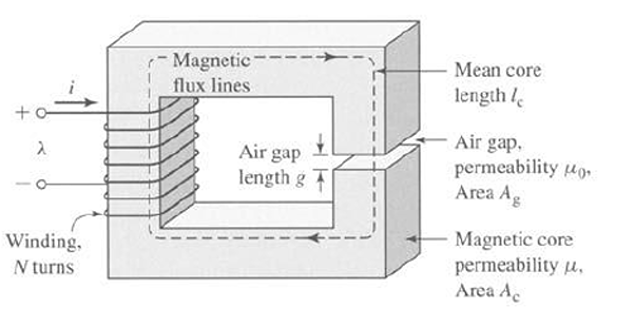
The reluctance of the iron path, with \(l_c = 0.3\ \text{m}\) and \(A_c = 9\times10^{-4}\ \text{m}^2\):
The reluctance of the gap, which carries no \(\mu_r\) at all because air is not magnetic:
Half a millimetre of air has 117 times the reluctance of thirty centimetres of this core — a length ratio of 1:600 reversed into a reluctance ratio of 117:1 by the factor \(\mu_r\).
They are in series, since the same flux passes through both:
The flux follows from the required core density, and with no fringing the gap carries the same flux over the same area:
The current is then the mmf shared out over the turns:
Of the 401 AT required, the gap absorbs 398 and the iron 3.4. Deleting the core term entirely would have changed the answer by less than one per cent.
Key Formulas
| Quantity | Relation | Notes |
|---|---|---|
| Magnetic Ohm's law | \(\mathcal{F} = \Phi\,\mathcal{R}\) | mmf drives flux through reluctance — Problem 1 |
| Coil mmf | \(\mathcal{F} = NI\) | Ampere-turns; unit written as A |
| Reluctance | \(\mathcal{R} = \dfrac{l}{\mu_0\mu_r A}\) | Metres and m2 throughout |
| Air-gap reluctance | \(\mathcal{R}_g = \dfrac{g}{\mu_0 A_g}\) | No \(\mu_r\) — Problem 5 |
| Series paths | \(\mathcal{R} = \mathcal{R}_c + \mathcal{R}_g\) | Same flux in each — Problem 5 |
| Flux density | \(B = \Phi/A\) | Compute before choosing \(\mu_r\) |
| Field strength | \(H = \dfrac{B}{\mu_0\mu_r}\) | \(B/\mu_0\) only in air — Problem 1 |
| Ampere's law | \(\mathcal{F} = Hl\) | Equivalent to \(\Phi\mathcal{R}\) |
| Permeability | \(\mu = \mu_0\mu_r = B/H\) | A function of \(B\) — Problems 2, 3 |
| Free space | \(\mu_0 = 4\pi\times10^{-7}\ \text{H/m}\) | Also written \(1.2566\times10^{-6}\) |
| Mean ring path | \(l = \pi d\) | Mean diameter, not radius — Problem 3 |
| Solenoid field | \(H = NI/l\) | Length of the winding — Problem 4 |
| Inductance | \(L = \dfrac{N\Phi}{I} = \dfrac{N^2}{\mathcal{R}}\) | Operating-point value — Problem 2 |
| Inductance on reversal | \(L = \dfrac{N\,\Delta\Phi}{\Delta I}\) | Factors of 2 cancel — Problem 2 |
Common Mistakes
Writing \(H = B/\mu_0\) for an iron path. That form belongs to air alone. In steel it is \(B/\mu_0\mu_r\), and omitting \(\mu_r\) inflates the required mmf by a factor of several hundred — Problem 1.
Leaving areas in mm2 or cm2. 500 mm2 is \(5\times10^{-4}\ \text{m}^2\) and 3 cm2 is \(3\times10^{-4}\ \text{m}^2\); a single missed conversion moves the answer by \(10^{4}\) — Problems 1 and 3.
Treating \(\mu_r\) as a property of the metal. The same mild steel is 380 at 1.6 T and about 899 at 1.13 T. Find \(B\) first, then take the permeability that belongs to it — Problems 1, 2 and 3.
Using the ring's diameter as the path length. The flux travels the mean circumference \(\pi d = 62.8\) cm, not the 20 cm diameter — Problem 3.
Confusing field strength with mmf. \(H\) is in A/m and \(\mathcal{F} = Hl\) is in A; the two differ by the path length and are not interchangeable — Problems 1 and 4.
Halving or doubling the reversal inductance. Both \(\Delta\Phi\) and \(\Delta I\) double on reversal, so \(L = N\Phi/I\) stands unchanged — Problem 2.
Quoting one quantity to inconsistent precision. A reluctance rounded to \(1.68\times10^{6}\) in one line and \(1.677\times10^{6}\) in the next produces two different mmfs for the same circuit; fix three significant figures and keep them — Problem 1.
Expecting iron-like flux density from a coreless coil. A solenoid on a brass tube develops \(B = \mu_0 H\), under a milli-tesla here — Problem 4.
Neglecting a sub-millimetre air gap. Half a millimetre of air outweighs thirty centimetres of core by a factor of 117; it is the iron that may be dropped, never the gap — Problem 5.
Five problems have fixed the whole vocabulary: mmf, flux, reluctance, flux density, field strength, permeability and inductance, tied together by \(\mathcal{F} = \Phi\mathcal{R}\) and its equivalent \(\mathcal{F} = Hl\). Nothing in the rest of Part 1 needs a new law — only new geometries to apply these to.
Problem 5 has already shown where the interest lies. Once a path is interrupted, the interruption takes almost all of the mmf, and the iron becomes a detail. Every rotating machine is built round exactly such a gap, because that is where the flux crosses from stationary to moving parts and where the energy conversion happens.
Next: Set 2 — Magnetic Circuits with Air Gaps, where gaps appear in series and in parallel, where the inductance and stored energy of a gapped core are computed, and where a core too saturated for a constant permeability is handled from its magnetisation curve instead.